
Equipment care · 4 min read
How to Clean Pool Balls and Know When to Replace Them
Cleaning removes dirt and residue; it does not restore missing material or certify a worn ball. Work away from the table cloth, use only a process approved for the identified material, inspect each ball under good light and log anything removed from play.
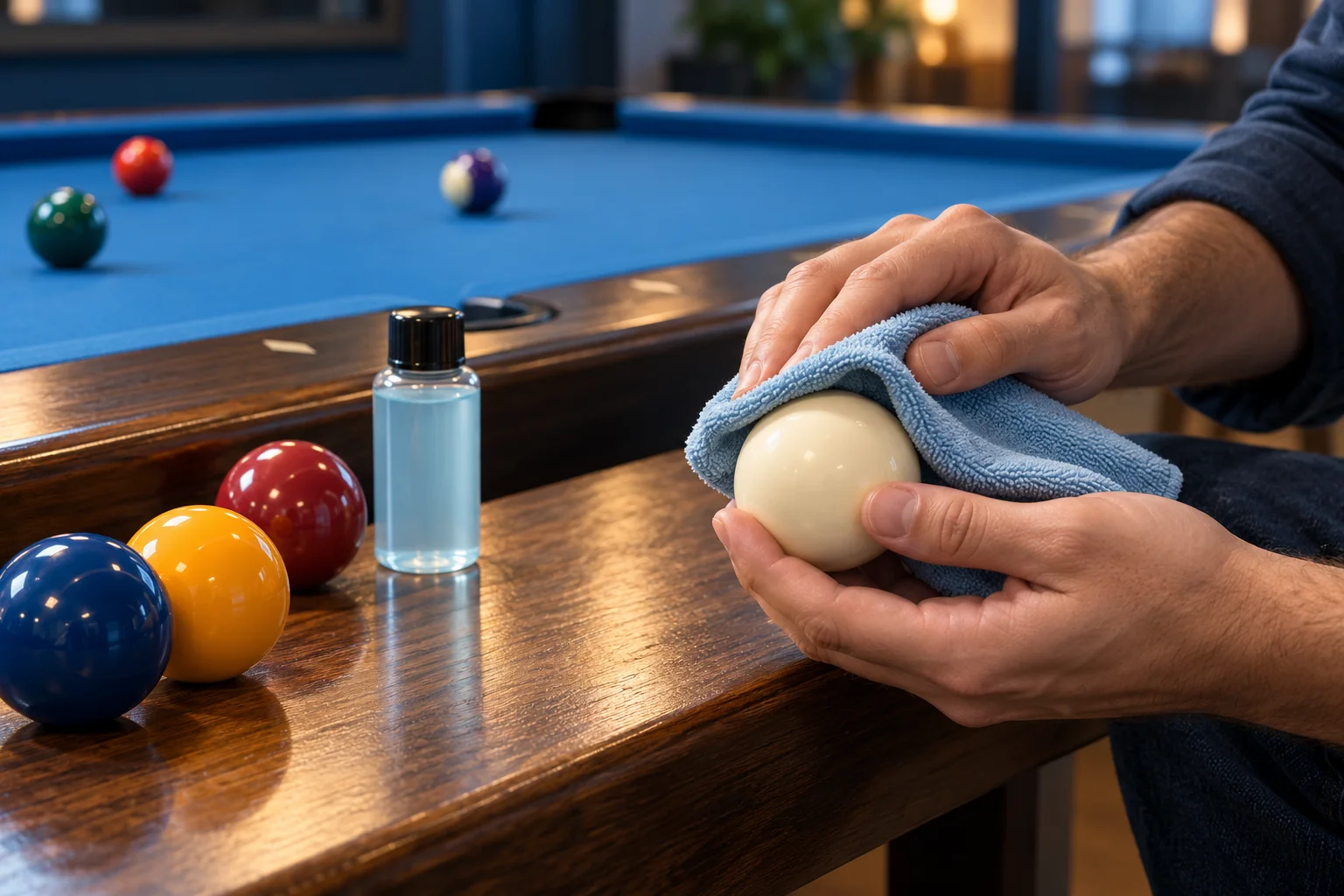
Triage the set before cleaning
Photograph questionable damage before applying anything. Place a quarantined ball in a separate container so it cannot return to play by mistake. A glossy finish does not make a crack, chip or size mismatch acceptable.
| Observation | Action | Do not |
|---|---|---|
| Loose dust or ordinary surface residue | Move to the approved cleaning routine | Assume stronger chemistry is faster |
| Unknown ball material or unidentified vintage set | Pause and obtain care guidance | Experiment on the playing set |
| Chip, crack, missing material or a sharp edge | Quarantine and ask about replacement | Sand or coat the defect |
| One stubborn mark | Record and follow the identified maker's process | Escalate repeatedly without a limit |
| Several mismatched or damaged balls | Assess the whole set | Treat shine as proof of consistency |
Use the competition guidance as a bounded baseline
The current World Pool Association rules page links equipment specifications that call for competition balls to be clean and unwaxed. The document permits a clean dirt-free cloth and soap and water, and it requires removal of slippery contamination before play. Those are competition-preparation statements, not universal chemical compatibility instructions for every resin, coating or vintage ball.
For a known set, follow its current care directions. If the material cannot be identified, stop before applying a chemical cleaner, polish, solvent or abrasive. The safe decision is an evidence gap, not a guess.
Follow a controlled hand-cleaning sequence
Work one ball at a time so a failed inspection remains traceable. Do not add a protective coating or extra product because the ball looks less glossy than expected. The target is a clean, dry playing surface, not maximum shine.
| Step | Action | Check before continuing |
|---|---|---|
| 1 — Prepare | Cover a stable bench with a clean towel; keep liquid off cloth and rails | No grit on towel or hands |
| 2 — Identify | Record set identity, material and approved process | Unknowns are marked and paused |
| 3 — Clean | Use the smallest amount and method allowed by the applicable directions | No uncontrolled dripping or abrasive contact |
| 4 — Finish | Remove residue and dry as directed | Surface is dry and not slippery |
| 5 — Inspect | Rotate each ball under good light | No crack, chip, sharp edge or remaining film |
| 6 — Store | Return only passed balls to a clean tray or box | Container is dry and free of grit |
Bound any stubborn-mark attempt
Before a second pass, record the location and appearance of the mark. Use only a product and sequence documented for that identified ball. Stop when the permitted process is complete; repeated polishing is not a substitute for a damage assessment.
A remaining cosmetic mark and a structural defect are different decisions. If you cannot distinguish them, quarantine the ball and ask the maker, supplier or qualified table technician. Restoration cannot add missing material or verify roundness.
Treat a machine as its own equipment system
Do not copy a cycle time from another machine or extend a cycle because the balls appear dull. A venue should record the machine, product, date and any removed ball so the next operator can repeat the same bounded process.
| Question | Required record |
|---|---|
| Is the ball material supported? | Named compatible material or set |
| Which liquid is permitted? | Exact product and amount |
| How are balls loaded? | Capacity and placement |
| What ends the cycle? | Documented time or condition |
| How are pads maintained? | Cleaning/replacement instruction |
| Who checks the result? | Named operator and inspection log |
Use a care log to make the replacement decision
If several balls are mismatched, visibly damaged or cannot be identified, compare a documented matched set with individual replacement cost and availability. Keep that buying decision separate from cleaning.
When investigating an unexplained roll, start from a clean set and repeat the observation on different table areas. One drift does not distinguish the ball from cloth, level, debris or stroke.
- Date, table and set identity.
- Cleaning method and product, or unknown when not established.
- Ball number or cue-ball description.
- Observed residue, mark or damage.
- Pass, quarantine or replacement decision.
- Photo reference and person responsible for follow-up.
Choose a complete pool-ball set when replacement extends beyond one known ball.
Inspect balls before practice for a faster pre-session routine.
Sources and further reading
References support the specific factual information above. The practical checklists are Ariakon editorial guidance.