
Pool science · 3 min read
Why Ordinary Pool Would Behave Differently in Microgravity
This is a thought experiment, not a claim that astronauts play standard pool aboard the International Space Station. Pool collisions still obey the laws of motion in microgravity, but the familiar game depends on gravity holding the balls against a flat cloth surface. Remove that condition and the table, stroke and pockets all need a redesign.
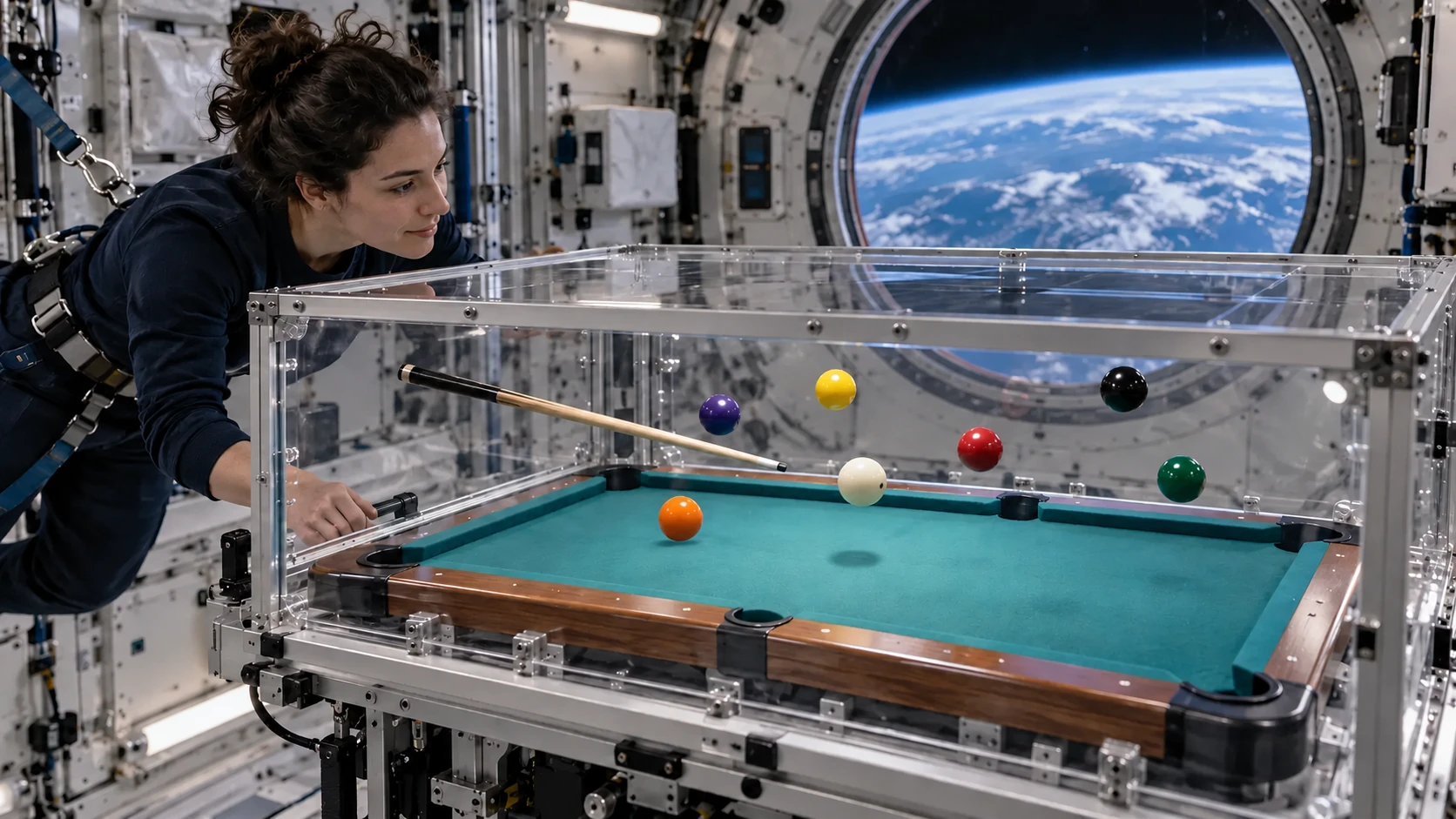
Microgravity is continuous free fall
NASA explains that a spacecraft and the objects inside it appear weightless because they are falling around Earth together. Gravity has not disappeared. The shared free fall greatly reduces the normal force that would otherwise press a ball onto the table bed.
A loose pool ball would therefore not simply settle onto the cloth in the familiar way. A player, cue and ball also need restraint because pushing one object produces a reaction on the other.
A regulation table assumes down
WPA equipment specifications call for a stable, level table with a flat rectangular playing surface, defined cushion height, cloth and downward pocket behavior. Those features create a repeatable two-dimensional game because gravity keeps each ball in contact with the cloth.
On Earth, rolling resistance slows the ball, cushions return it across the plane and a pocket lets it fall below that plane. Those are not optional decorations; together they define how ordinary pool works.
Collisions would still transfer momentum
The laws of motion continue to apply. A moving cue ball would keep moving until a force changed its motion, and a collision would exchange momentum between the balls. The strike could still create rotation, but without sustained cloth contact that spin would not produce the same roll, draw, follow or swerve players expect.
A cueing error would also have three-dimensional consequences. The ball could leave the intended plane instead of being restored toward the bed by gravity.
Rails and pockets would lose their normal roles
A ball approaching an open cushion might pass above or below the cushion nose. A conventional drop pocket would not reliably capture a ball because there is no useful downward direction relative to the table.
Cloth friction would act only while something holds the ball against the surface. Without that restraint, familiar speed control, tangent-line development and multi-rail routes would not translate directly.
A space version would be a different game
A practical experiment would need a sealed transparent enclosure, a way to constrain balls to a plane or capture them in three dimensions, controlled rebounds and secure anchors for the player and cue. Safety and spacecraft operations would govern the design long before familiar pool rules did.
Even then, it would be an engineered collision game inspired by pool rather than standard pool transported unchanged into orbit. That distinction keeps the science honest.
Bring the thought experiment back to Earth
- Notice how table level determines whether a slow ball holds its line.
- Compare slide, roll and spin as cloth contact changes motion.
- Observe that cushions return balls only near their designed nose height.
- Use a stop shot to separate collision direction from later rolling effects.
- Treat pockets as geometric openings plus gravity-assisted capture.
- Remember that this conceptual exercise is not evidence of an actual orbital pool match.
Sources and further reading
References support the specific factual information above. The practical checklists are Ariakon editorial guidance.