
Equipment guides · 3 min read
How to Compare Pool Cue Chalk Without Guesswork
Cue chalk helps the tip grip the cue ball during off center contact. That basic function does not make one brand automatically best for every player, tip, cloth or maintenance preference. A fair comparison keeps the shot, tip condition and application method stable, then records useful outcomes instead of scoring packaging or price alone.
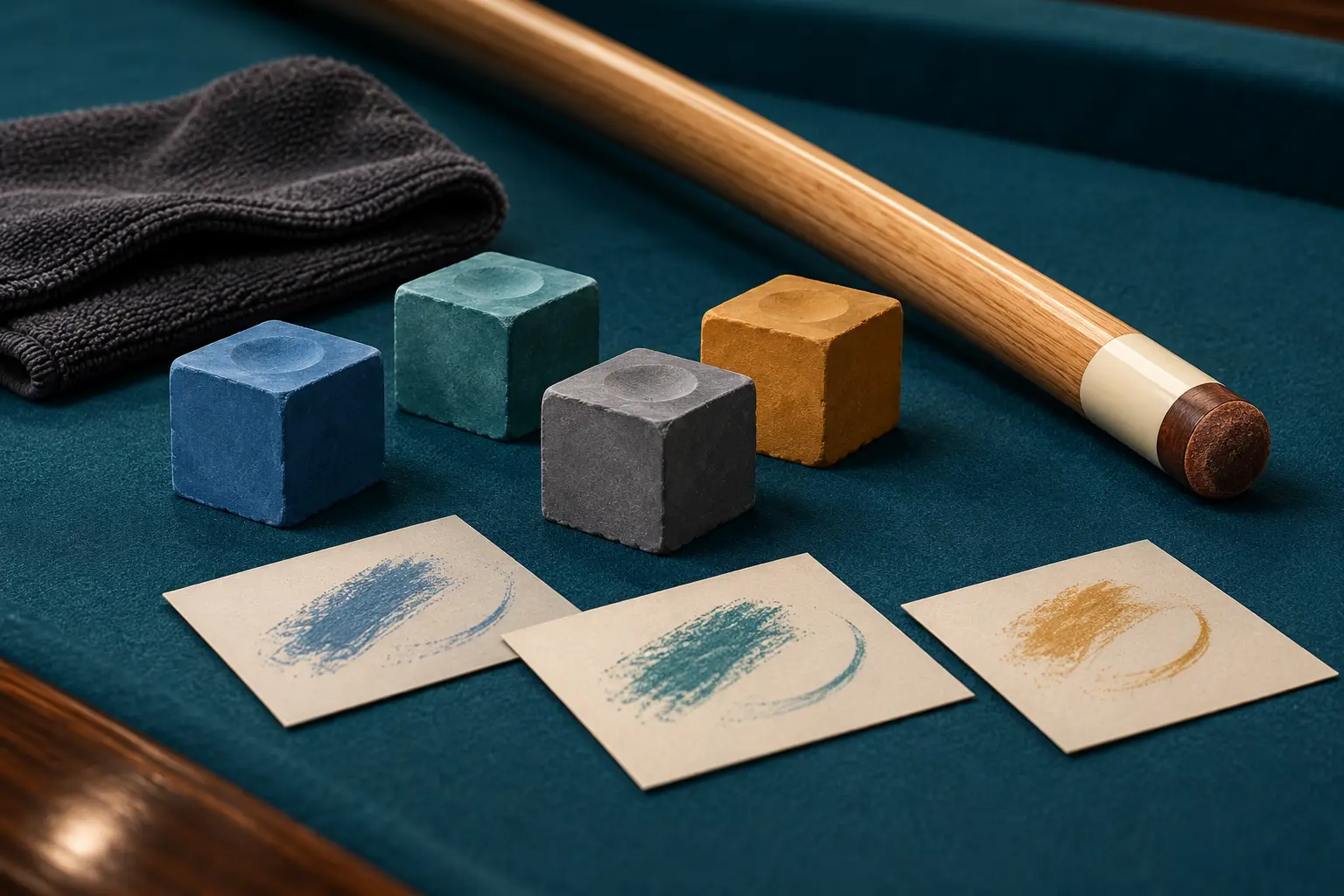
Begin with the job chalk performs
Physics research on cue and ball deflection describes how an unchalked tip can slide during an off center hit while a chalked tip can grip. The current WPA rules also identify insufficient chalk as one possible cause of a miscue. Chalk reduces risk; it does not make every tip offset or stroke legal and reliable.
A miscue can also involve delivery, tip condition or an attempted contact too far from center. Do not treat every miscue as a product failure. Inspect the tip and use a shot you can normally execute before comparing chalks.
Control the test conditions
- Use the same cue, tip and cue ball for every sample.
- Clean the cue ball using its manufacturer’s directions before the session.
- Use one repeatable shot and one speed.
- Apply each chalk with the same light brushing motion and coverage.
- Test an equal number of attempts and record all results.
- Keep the table, cloth condition and room conditions as consistent as practical.
Score grip without chasing maximum spin
Choose a modest follow, draw or sidespin shot inside your reliable range. Take ten attempts with fresh application before each shot. Record miscues and visibly incomplete coverage. If every sample completes the shot without a miscue, the test has reached a tie for that task; do not move the tip farther from center simply to force a winner.
A product that supports your normal shot is doing the essential job. Extreme offsets introduce more stroke variability and can make the comparison less relevant to actual play.
Measure residue and transfer separately
After a fixed number of shots, inspect the cue ball and cloth under the same light. Note visible transfer, loose particles and how easily the marks clean using approved methods. Do not rub the cue ball with an abrasive or add a household cleaner during the comparison.
Residue is a maintenance preference, not direct proof of grip or shot accuracy. Keep its score separate so a clean product does not receive credit for a shot result it did not produce.
Include application feel and cube durability
Record whether you can see even coverage on the tip, whether the cube chips during ordinary use and whether the wrapper or shape is comfortable to handle. Avoid grinding the cue tip into the cube, which can create a deep hole and waste material.
Repeat the check after several sessions. A new cube comparison can miss crumbling, drying or accumulation that appears later. Store samples as directed by the maker and keep them from rubbing against cues and cloth inside a case.
Calculate practical cost honestly
Compare the price you actually pay, the number of cubes and how quickly each cube wears under the same use. Do not convert a short test into a lifespan claim. A higher price may be reasonable if you value cleaner use or a preferred application feel, but it does not prove better play.
When two samples perform the same for your normal shots, availability and maintenance may decide the purchase. Keep the conclusion personal and bounded: best for this cue, test and player, not best for everyone.
Use a simple comparison card
- Ten attempts completed without a miscue.
- Coverage visible before each shot.
- Cue ball transfer after the fixed set.
- Loose residue on cloth or hand.
- Application comfort and cube condition.
- Current price and availability.
- Date, cue, tip and table used.
Sources and further reading
References support the specific factual information above. The practical checklists are Ariakon editorial guidance.