
Fundamentals · 3 min read
Build a Repeatable Pool Pre-Shot Routine
Consistency begins before the cue moves. A pre-shot routine separates decision making from delivery: you choose the shot while standing, see the line, approach it deliberately and then execute without reopening the entire debate over the cue ball.
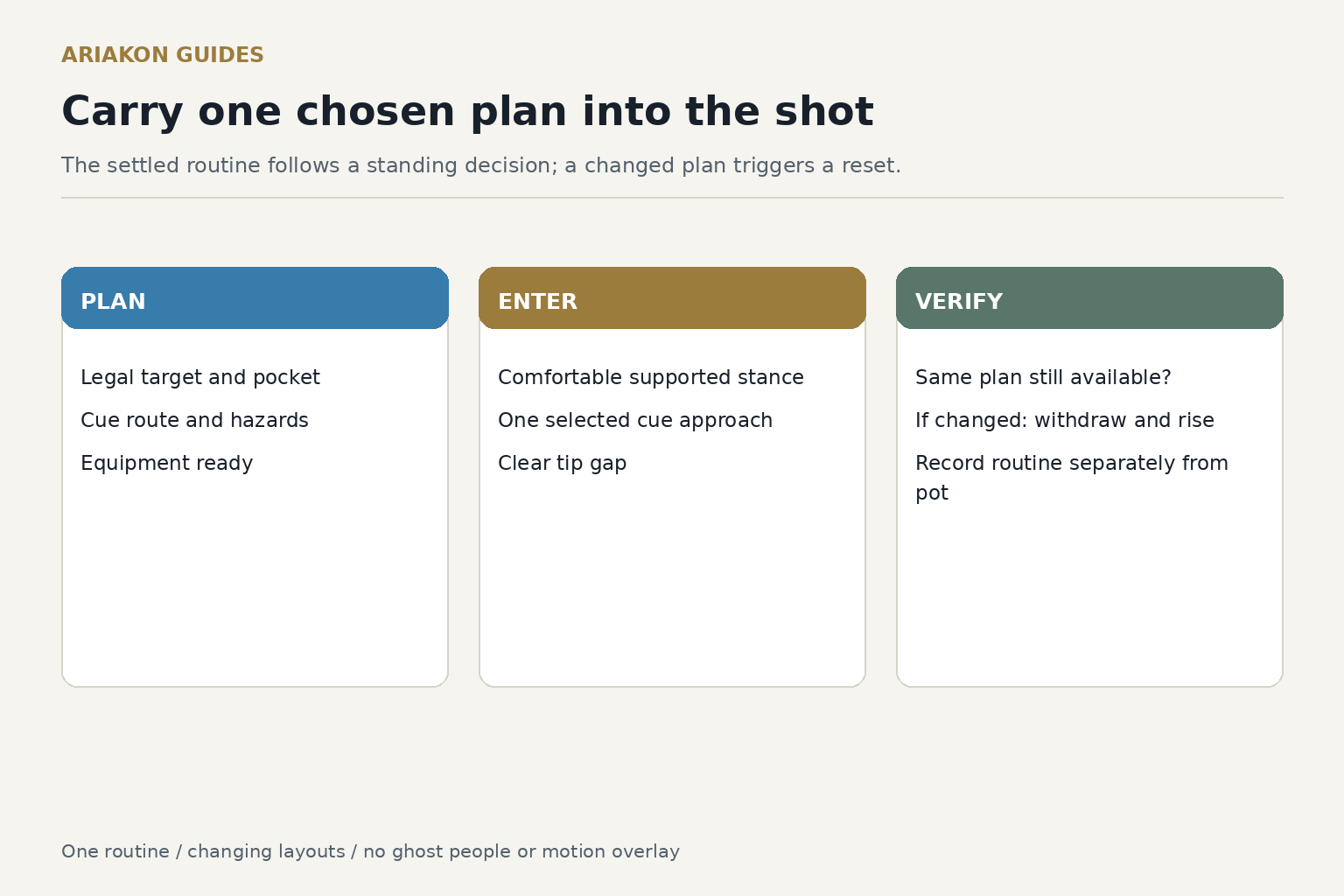
Finish the decision while standing
Name the pocket or safety target, cue-ball route, speed and intended tip contact before bending down. Look for scratch lines and traffic. If the plan is incomplete, remain upright.
Include necessary equipment preparation and route selection before the approach. A few warm-up strokes cannot repair an undecided pocket or an unsafe cue path.
See the line from behind
Stand where you can see the object-ball contact line and the cue-ball path together. Use the standing view to inspect the whole layout before choosing one cue approach.
Choose one visual target that makes sense to you—the contact point, ghost-ball center or a line through the balls—and keep it stable through the approach. Mixing several aiming pictures in the middle of the stroke creates uncertainty.
Walk onto the chosen line
- Place the cue on the visual line before the stance closes around it.
- Let the lead foot and body settle without pushing the cue sideways.
- Form the bridge at a comfortable, repeatable length.
- Check that the grip forearm can swing freely.
- Keep the head quiet once the final address is established.
Use a clear set, pause and finish
Warm-up strokes should confirm the line and speed, not search indefinitely. In the set-pause-finish sequence, the cue settles near the cue ball, the player pauses before the final backswing, and the stroke finishes through the intended contact.
The exact rhythm can be personal. What matters is that it is deliberate, comfortable and repeatable. Do not add a long pause merely because another player uses one.
Stand up when the picture changes
A routine is not a command to shoot after you notice a problem. If the line, bridge, speed or tip contact feels different from the plan, stand up, step back and begin again.
This reset should be normal rather than dramatic. It protects the distinction between planning and execution and prevents a last-second steering motion.
Train the sequence before judging results
Use simple straight shots and score whether you completed each routine step, separately from whether the ball fell. Video a few repetitions from behind and from the side to check approach, head movement and tempo.
Once the sequence feels natural, apply it to cuts, safeties and position shots. The shot choice will change; the order of planning, sighting, stepping in, settling and finishing should remain recognizable.
Keep an exact ordinary baseline for this record
Coordinates are ball centers on an illustrative 100 by 50 inch bed: x=0..8 along length, y=0..4 across width, origin at the lower left cushion nose. One unit is 12.5 inches. For 2.25 inch equal balls, radius is 0.09 and diameter 0.18 units. Intact cushion center boundaries are x=0.09,7.91 and y=0.09,3.91; pockets interrupt the physical boundary at the four corners and (4,0),(4,4). Measure actual bed, balls and jaws before scaling. Remove every measuring aid before shooting; never mark a competition table.
Use O(6,3), real upper right corner P(8,4), intended contact cue center G(5.839003,2.919502) and C(4.944576,2.472288). With u=(2,1)/sqrt(5), G=O minus 0.18u and C=G minus u. The centers are collinear and the equal balls are tangent at G.
Choose a comfortable ordinary pace and keep equipment fixed. Record actual strikes, known legal pots and the task-specific observation separately. A chosen cue-rest window, when needed, is a radius 0.18 disk about G; it is not a guaranteed result. Unknown observations stay unknown, and a safety stop leaves later allocations unused. Use the exact mirrored setup x→8−x only in a separately dated transfer record.
Sources and further reading
References support the specific factual information above. The practical checklists are Ariakon editorial guidance.