
Fundamentals · 4 min read
Choose the Right Hand Bridge for Each Pool Shot
Choose a bridge that supports and guides the cue without binding or moving another ball. Open, closed and rail bridges solve different clearance conditions. Compare open and closed on the same easy task, but judge a rail bridge on its own constrained setup instead of declaring a winner from unlike shots.
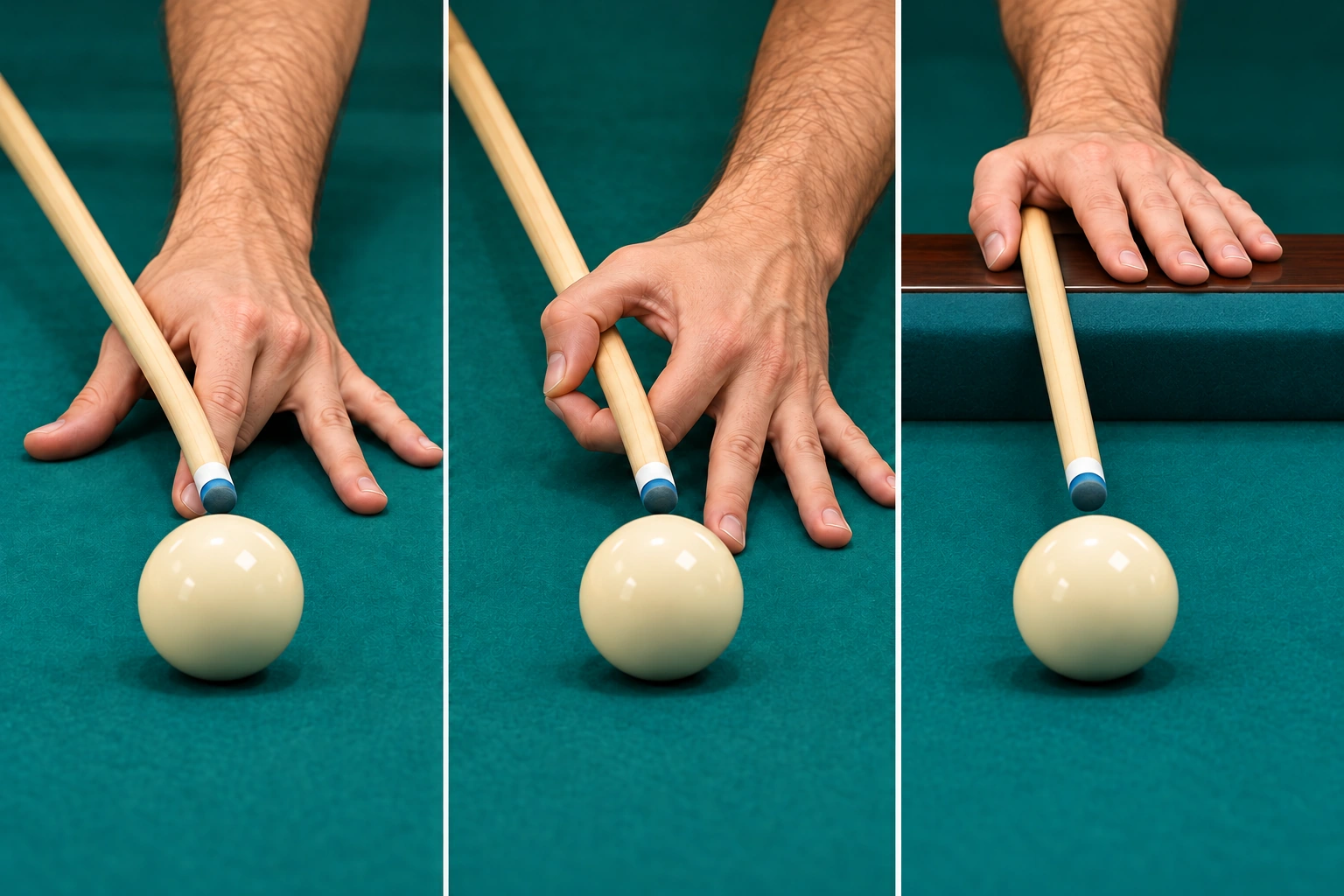
Check support and free travel before touching a ball
Use a comfortable hand arrangement with normal anatomy, not a forced photographed shape. The cue must slide through the intended delivery range. A closed ring guides the shaft; it is not the grip hand. A rail bridge may need a shorter stroke because the cue ball is close. No style guarantees straight delivery.
Make five unstruck sliding checks per available bridge: fifteen movements if all three are usable. Keep the tip clear of every ball. These are not fifteen shot attempts or proof of centered tip contact. Stop for discomfort or unsafe reach; use room-approved mechanical support when needed.
| Bridge | Support to establish | Reject before shooting |
|---|---|---|
| Open | Heel/fingers comfortably planted; thumb/index form a stable V | Cue falls from guide or base shifts |
| Closed | Index forms a loose loop; other fingers and heel support the base | Fist grips cue, pinching or uncomfortable ring |
| Rail | Cue rests on suitable cushion/rail support; hand safely guides it | Cue floating without support or hand near an interfering pocket |
Use a mechanical bridge when safe hand support is unavailable rather than stretching to imitate a picture.
Compare open and closed on one repeatable pot
Use ball-center coordinates on an illustrative 100×50-inch bed: x=0..8 along the length, y=0..4 across it, origin at the lower-left cushion-nose corner. Equal 2.25-inch balls have radius 0.09 and diameter 0.18 units. Intact-cushion center limits are 0.09..7.91 and 0.09..3.91. Real pockets interrupt the boundary at four corners and (4,0),(4,4). Measure your actual bed, balls and pocket mouths before scaling. Remove measuring aids before shooting and never mark a competition table.
Use O(6,3), corner P(8,4), contact G(5.839003, 2.919502) and cue start C(4.944576, 2.472288), one unit behind G on the pocket line. Choose comfortable bridge length and pace, no intentional sidespin, and a familiar stop request. Keep the same start, cue and chalking for both hand styles.
Shoot six attempts with each, alternating open/closed until twelve strikes finish. Keep support-retained and legal called-pocket outcome separate. Support passes only when the base stays stable and the shaft slides without binding through delivery; an obscured view is unknown, not a pass. A pot does not prove intended tip contact.
| Style | Support result | Object result |
|---|---|---|
| Open — 6 | Pass/observed fail/unknown, denominator only observed | Legal called pots / actual strikes |
| Closed — 6 | Same checks and visibility | Same called pocket and pace request |
Test the rail constraint separately
Use only cue ball C(2,0.22), near the lower cushion, with finish disk radius 0.25 centered at (2,2). The backward centerline meets lower rail x=2, away from pocket mouths. The cue approaches across that rail, not shallowly along it. There is no object-ball pot in this task. Confirm a low unobstructed line, adequate tip room, no nearby pocket mouth, and cushion/rail support beneath the shaft. Do not copy the open/closed pot score onto this cue-only test.
Take six cue-only strikes: eighteen total struck attempts across all tasks if completed. Record stable free support and actual disk finish separately. The route is a modest direct cloth path, not a prescribed elevated stroke. Do not hit harder to overcome a binding hand.
| Field | Success boundary |
|---|---|
| Support | Cue supported below, hand planted, no binding or unintended contact |
| Finish | Cue center at rest within the stated disk |
| Stop | Insufficient tip clearance, discomfort, instability or uncontrolled cue |
Select a default and a fallback from actual evidence
Hypothetical open: 5/6 pots, support 5/5 observable plus one unknown. Closed: 4/6 pots, support 6/6. This small comparison suggests a comfortable default and a visibility question, not universal superiority. Rail 4/6 disk finishes is a different task and cannot join the pot denominator.
If both standard bridges work, keep the simpler comfortable option for that task and retain the other for specific clearance. Bridge length is a separate variable. Elevated bridges over obstacles require their own clearance assessment; do not turn this worksheet into a jump or massé lesson. Recheck nearby balls and use safe support instead of forcing a shape.
Compare bridge length as a separate variable after the base and free slide are settled.
Check the rest of the fundamentals when the support stays stable but misses persist.
Sources and further reading
References support the specific factual information above. The practical checklists are Ariakon editorial guidance.