
Practice drills · 4 min read
A Progressive Rail First Pool Shot Drill
On a rail first shot, the cue ball contacts a cushion before reaching the object ball. The route can help pocket a ball near a cushion or change the cue ball path, but a small error in rail contact can create a large change after the rebound. This drill begins with a visible, forgiving contact and adds difficulty only after the result becomes repeatable.
Understand what the shot must accomplish
Choose one object ball close to a long rail and a nearby corner pocket. The cue ball must reach the cushion just before the object ball, then rebound into the object ball. This differs from a bank, where the object ball itself is intentionally sent to a cushion before the pocket.
During ordinary WPA play, a legal shot still has to satisfy the game’s first contact requirement. If no ball is pocketed, at least one ball must reach a rail after the cue ball contacts the legal object ball. A practice success condition can be stricter than the rule, but it must not be confused with a universal rule.
Build a forgiving starting layout
Place the object ball about one ball width from a long rail and roughly one diamond from a corner pocket. Put the cue ball on a shallow approach angle where a center ball hit can reach the cushion shortly before the object ball. Use a comfortable bridge and avoid a layout that forces the cue over another ball.
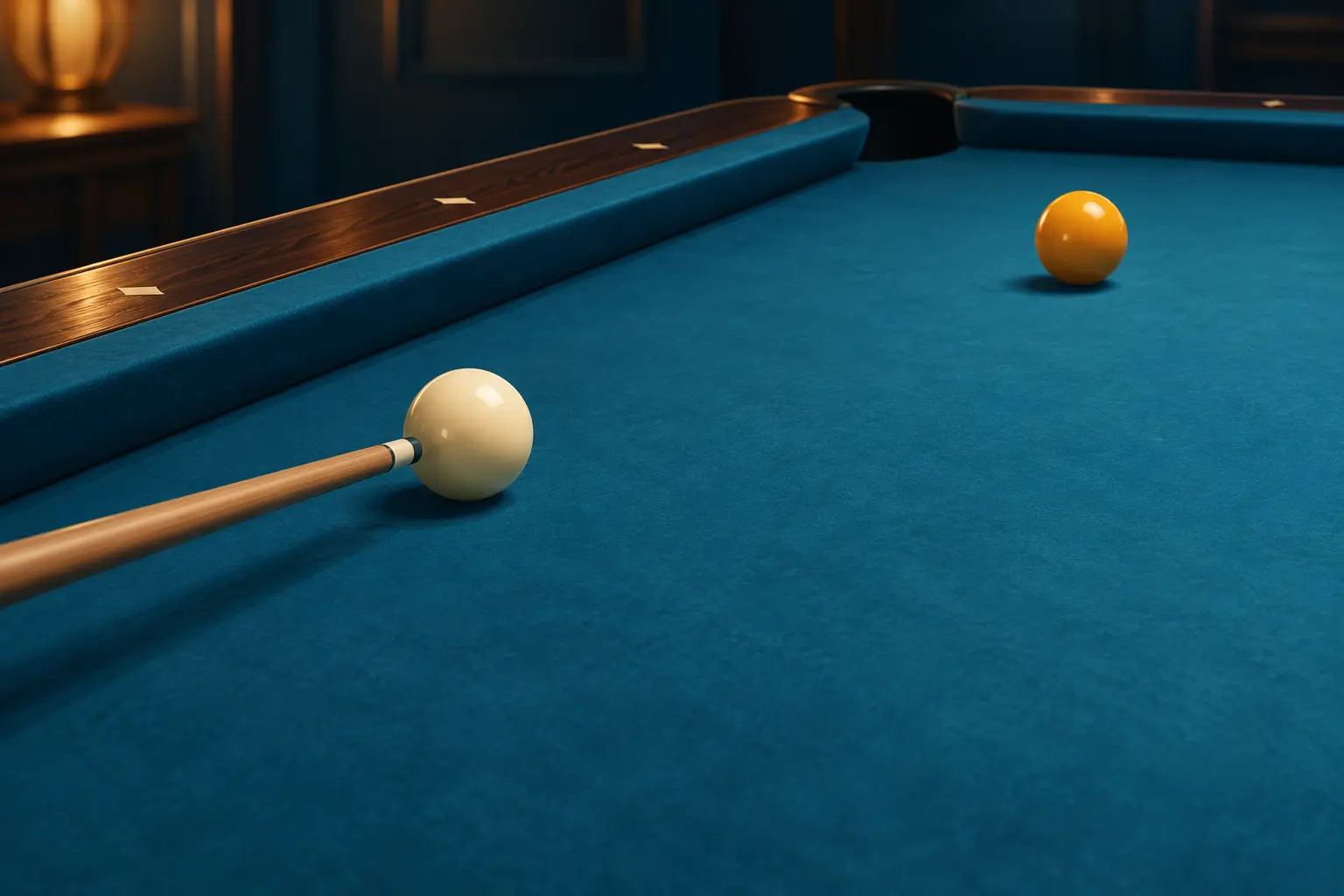
Photograph the layout or note the nearest diamonds. The illustration on this page is editorial, not a scaled shot diagram. Confirm the real line at the table and leave enough clearance that the cue ball cannot be trapped between the ball and cushion.
Begin with center ball and medium soft speed
Shoot ten attempts with no intentional sidespin. Your first goal is not perfect position. It is recognizing the rail contact point and delivering the cue through the chosen line. Record pocketed balls, misses toward the rail and misses away from the rail.
If the object ball reaches the rail before the pocket, the hit may be too full or the cue ball may have rebounded too early. If the object ball is undercut, the cue ball may have reached the rail too late. Use the observed contact and result, not a single guess, to make a small adjustment.
Add a cue ball target
After you make at least seven of ten from the base layout, place a generous target zone for the cue ball using two existing diamond references. Score one point for the pocket and one for finishing in the zone. Do not put objects on the cloth that could affect a ball.
The rebound angle depends on speed, spin, cloth and cushion conditions. Treat familiar angle rules as starting estimates. The purpose of this stage is to observe your table under controlled conditions.
Introduce spin only for a defined reason
Repeat the base shot with a small, consistent amount of spin only when you need to change the cue ball route. Chalk before the attempt, stay within a comfortable tip offset and keep the speed similar. Compare ten attempts with center ball and ten with the selected spin.
Do not interpret one dramatic result as proof that more spin is better. If pocketing accuracy drops sharply, reduce the offset or return to center ball until the rail contact is stable.
Progress distance before complexity
- Move the cue ball back half a diamond while leaving the object ball fixed.
- Repeat ten attempts and keep the same scoring.
- Mirror the layout on the opposite long rail in a later block.
- Change the object ball distance from the rail only after both directions are stable.
- End the progression when stance, speed or contact becomes inconsistent.
Transfer the skill to decisions
Set up three realistic choices: a direct ball first shot, the rail first route and a safety. Decide which gives the largest margin for the required cue ball position. Rail first is a tool, not a mandatory answer whenever a ball is near a cushion.
Finish with a short rack and note whether you recognized the route without forcing it. The useful result is better contact order and cue ball planning, not merely completing the fixed drill.
Sources and further reading
References support the specific factual information above. The practical checklists are Ariakon editorial guidance.