
Aiming · 4 min read
Understand Pool Ball Throw and Adjust for It
A missed cut is not automatically throw. The cue ball may have arrived on a different line before the balls touched, or the object ball may have departed differently during frictional contact. Keep those two observations separate before adding an aim compensation.
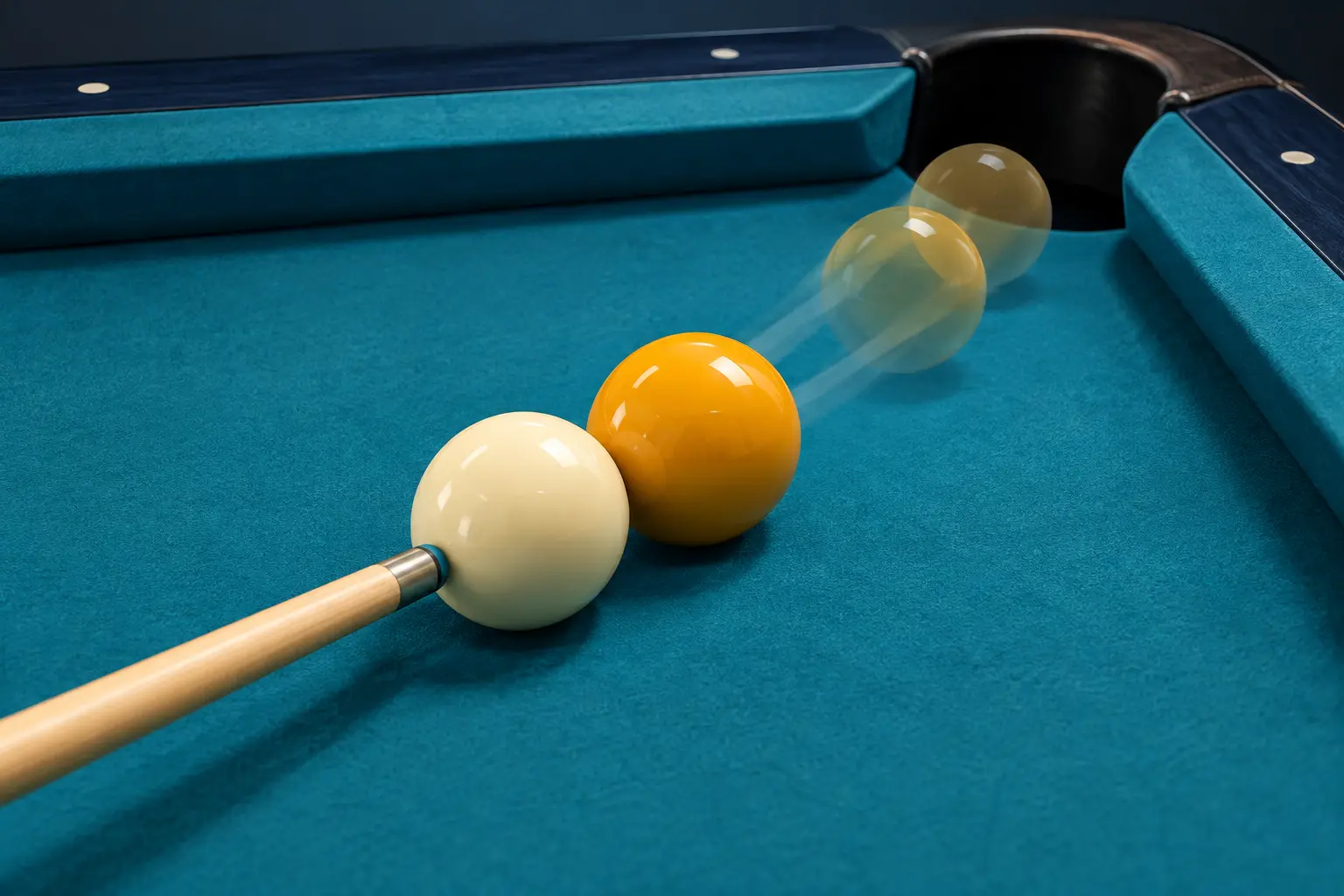
Locate where the deviation begins
Cut-induced throw is an object-ball direction change associated with rubbing contact on a cut. Sidespin can also produce throw. Squirt changes the initial cue-ball direction and swerve changes its later approach, so a sidespin miss mixes several possible causes. A pocket outcome alone cannot identify which occurred.
Slow stun on a moderate cut can show substantial throw; other arrival states, speeds and surface conditions can change it. There is no universal number of degrees to add, and rolling does not guarantee zero throw. Start on the vertical axis rather than testing a precise sidespin cancellation immediately.
Distinguish stun and rolling route references before changing intended arrival state.
Register a fixed geometric line before comparing deliveries
Use ball-center coordinates on an illustrative 100×50-inch bed: x=0..8 along the length, y=0..4 across it, origin at the lower-left cushion-nose corner. Equal 2.25-inch balls have radius 0.09 and diameter 0.18 units. Intact-cushion center limits are 0.09..7.91 and 0.09..3.91; real pockets interrupt the boundary at four corners and (4,0),(4,4). Measure your actual bed, mouths and balls before scaling this example. Remove all measuring aids before shooting; do not mark a competition table.
Use O(6,3), P(8,4), contact G(5.839003, 2.919502) and incoming C(5.122716, 1.834636) from the 30° cut construction. The friction-free O→P line crosses x=7 at y=3.5. This is a geometric reference, not the promised departure of a real ball.
A permitted overhead video must show the approach to contact and the object-ball crossing of x=7. Register scale from the table before shooting and keep the camera fixed. If the object passes beyond the field or crosses too few readable frames, record unknown rather than extrapolating from the final pocket miss.
Use matched pairs and keep the attempts bounded
Repeat A,B,B,A three times. This arrangement reduces a simple early/late practice-order bias but does not make the experiment a laboratory isolation of friction. Replace C and O, check ordinary approved ball care, and retain the same camera and aim. Never add chalk, saliva or another substance to manufacture friction.
Define signed residual as observed y at x=7 minus 3.5. Positive means larger y, negative smaller y. Do not label that universally overcut or undercut when the side of the shot changes. Record pots out of six separately from readable residuals and disclose unknowns.
| Delivery | Attempts | Frozen conditions | Record |
|---|---|---|---|
| A — intended stun | 6 | No intentional sidespin; stated comfortable pace request; exact balls | Approach consistency, signed crossing residual, pot |
| B — intended roll | 6 | Same geometric aim and equipment; arrival goal changed | Same observations, plus any changed pace request |
Do not compensate for a different collision
If the approach or actual contact differs between groups, repair that repeatability first. A residual change can reflect aim, collision, arrival spin, pace or ball condition. The record supports a hypothesis about throw only after those competing explanations have been considered.
For an illustrative measured crossing y=3.55, the direction from O to (7,3.55) differs from the reference by atan(0.55)−atan(0.5), about 2.245°. That computation describes this crossing; it is not a measured universal throw angle or a cue-tip offset. A camera with inadequate scale cannot justify that precision.
Retest a small aim change and inspect position again
If one condition repeatedly departs on the same signed side with a stable approach, choose one small geometric aim adjustment opposite that departure and write it down. Shoot six new attempts at that condition. Eighteen total strikes include baseline and retest. Keep actual contact and cue-ball finish observations because changing aim also changes the collision and position route.
Example notes might show four positive residuals and two unknown in A, while B scatters on both sides. Retest A’s repeated tendency; do not average unknowns as zeros or add outside spin to B by reflex. Transfer only a repeatable correction to similar speed, distance and ball conditions.
Test the thinner-cut margin as a separate question where delivery precision may dominate the adjustment.
Use a bounded camera review when the precontact line is the uncertain variable.
Sources and further reading
References support the specific factual information above. The practical checklists are Ariakon editorial guidance.