
Aiming · 4 min read
Build a Consistent Eye Pattern for Pool Aiming
Good vision at the table is not about staring harder. It is about giving each look a job. A repeatable eye pattern helps you verify the shot line, place the tip accurately and finish without a frantic last-second correction. The exact rhythm can differ between players; consistency and useful visual information matter more than copying someone else's count.
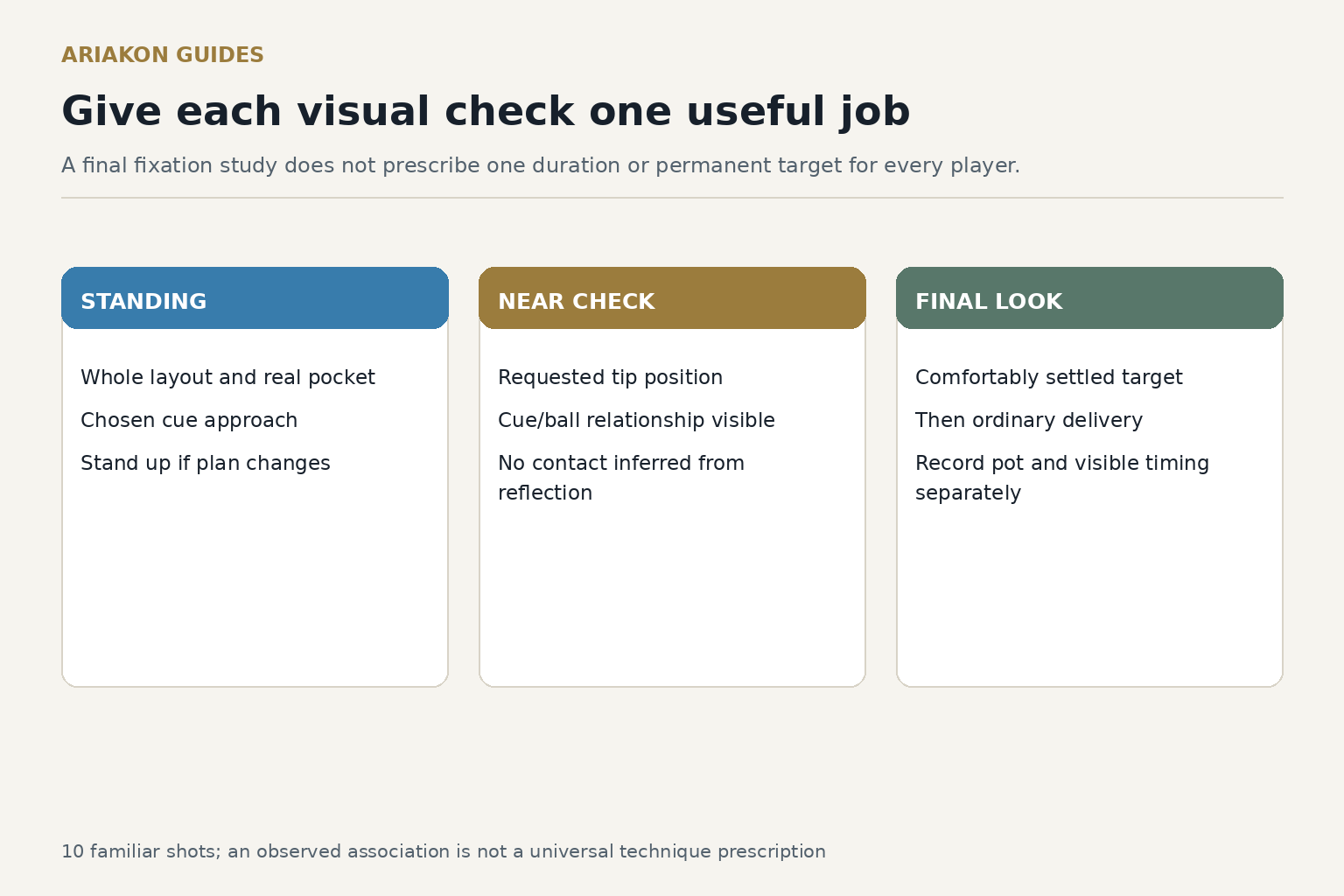
Aim while you are standing
See the object-ball path and the intended contact before lowering into the stance. From standing height, your eyes can take in the cue ball, object ball and pocket as one layout. Choose the shot line there, then step onto it.
If the line looks wrong after you settle, stand up and restart. Twisting the cue while down changes both the aim and your body alignment. A reset costs a few seconds and preserves a clean decision.
Give near and far checks different jobs
The cue ball is the near target. Look there to verify the intended tip contact and make sure the cue is not drifting across the ball. The object-ball contact or distant aiming target is the far target. Look there to confirm the delivery line.
Alternate deliberately during warm-up strokes: near for tip placement, far for line, then near again if a correction is required. Random rapid flicking can feel busy without providing a clear check.
Settle before the final stroke
Research on billiards aiming defines the quiet eye as the final fixation on a relevant target before movement begins. Skilled participants showed longer final fixations, and successful or more complex shots were associated with longer quiet-eye periods. Those are reported associations in that study, not proof that prescribing a longer fixation improves every player. A comfortable settled final look is a candidate habit to test.
This does not prescribe one universal duration or demand that every player finish on the same visual target. Choose a final target that keeps your stroke accurate—often the object-ball contact or aiming line—and keep the eyes still enough for the decision to finish.
Separate eye motion from cue motion
Complete the last visual check before the final backswing. Once the cue moves forward, avoid chasing the cue ball with your eyes or looking early toward position. Record visible gaze/head timing if the view supports it; do not infer hidden eye movement or a causal mechanism from a miss.
Hold your finish for a moment. A finish view can show the final head/cue position, but only a continuous readable view can establish when a movement began. It also gives you a clean view of the ball's actual path for the next adjustment.
Train the pattern on an easy shot
Set a straight-in shot at comfortable distance. Name four checkpoints: line while standing, tip while set, target during the last warm-up, target during the final pause. Shoot ten without caring about cue-ball position beyond a stop.
Then move the object ball farther away or add a modest cut. If misses increase, do not add more eye movements. Return to the four checkpoints and allow a little more settling time on the final target.
Diagnose one variable at a time
- Missing both sides: check whether you truly choose the line while standing.
- Tip landing inconsistently: spend a longer, quieter check on the cue ball.
- Steering during delivery: finish the far-target check before the cue moves.
- Moving the head early: hold the finish until the object ball reaches the pocket.
- Pattern collapses under pressure: use the same four checkpoints on every routine practice shot.
Keep an exact ordinary baseline for this record
Coordinates are ball centers on an illustrative 100 by 50 inch bed: x=0..8 along length, y=0..4 across width, origin at the lower left cushion nose. One unit is 12.5 inches. For 2.25 inch equal balls, radius is 0.09 and diameter 0.18 units. Intact cushion center boundaries are x=0.09,7.91 and y=0.09,3.91; pockets interrupt the physical boundary at the four corners and (4,0),(4,4). Measure actual bed, balls and jaws before scaling. Remove every measuring aid before shooting; never mark a competition table.
Use O(6,3), real upper right corner P(8,4), intended contact cue center G(5.839003,2.919502) and C(4.944576,2.472288). With u=(2,1)/sqrt(5), G=O minus 0.18u and C=G minus u. The centers are collinear and the equal balls are tangent at G.
Choose a comfortable ordinary pace and keep equipment fixed. Record actual strikes, known legal pots and the task-specific observation separately. A chosen cue-rest window, when needed, is a radius 0.18 disk about G; it is not a guaranteed result. Unknown observations stay unknown, and a safety stop leaves later allocations unused. Use the exact mirrored setup x→8−x only in a separately dated transfer record.
Sources and further reading
References support the specific factual information above. The practical checklists are Ariakon editorial guidance.