
Cue Ball Control · 5 min read
Use the Center of the Table to Simplify Position Play
A central cue ball is useful only when the next task remains reachable. This planning card compares two central windows against the same next ball and blocker, then records whether a chosen pace request produces a usable leave. It is not a promise that crossing the middle prevents scratches, nor the separate four-cut-angle route experiment.
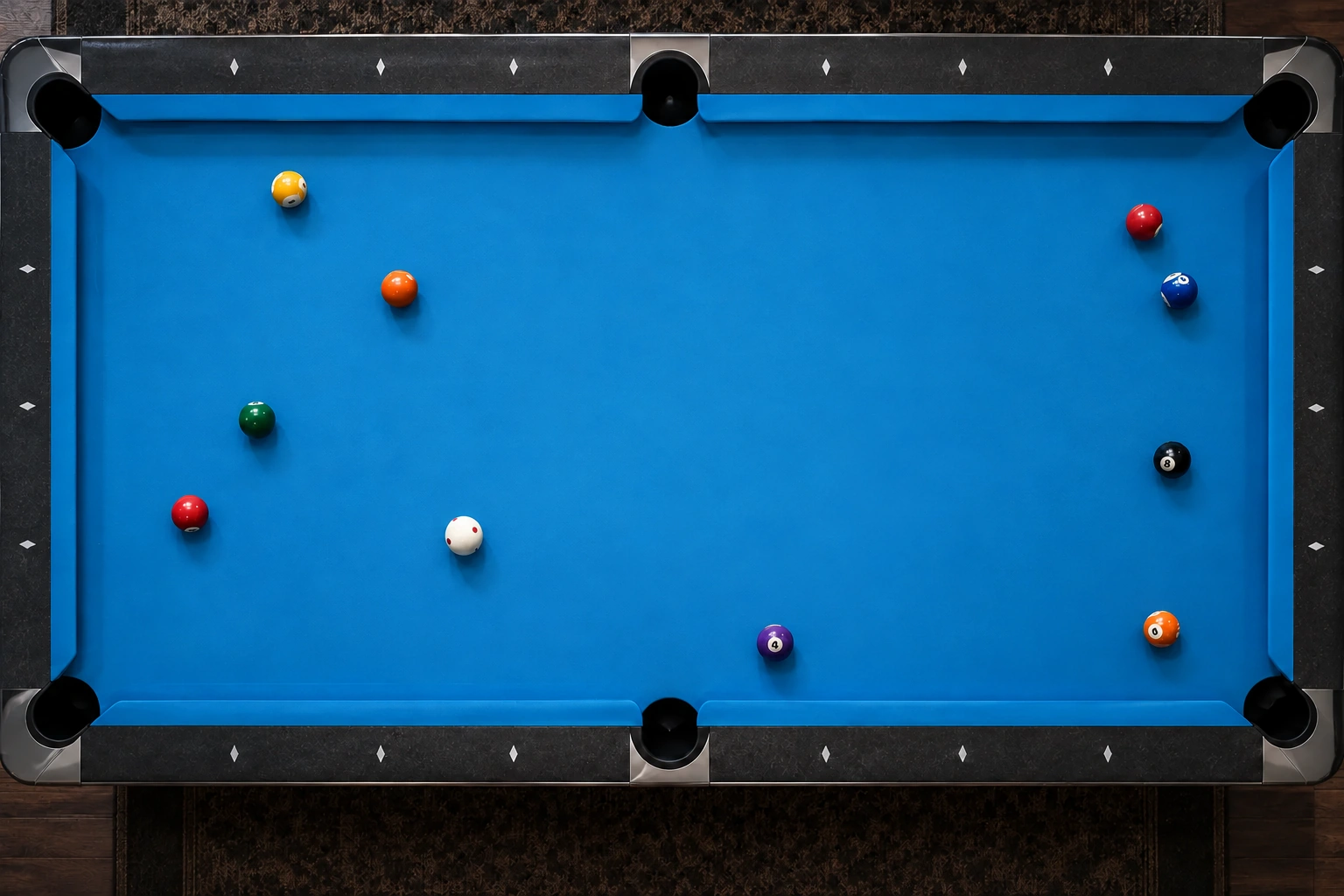
Define the next shot before drawing a center window
Coordinates describe ball centers on an illustrative 100×50-inch bed: x=0..8 along the length, y=0..4 across it, origin at the lower-left cushion-nose corner. One unit is 12.5 inches; equal 2.25-inch balls have radius 0.09 and diameter 0.18 units. Intact-cushion center limits are 0.09..7.91 and 0.09..3.91. The four corners and (4,0),(4,4) are real pocket locations, not spots inside the bed. Measure actual balls, bed, mouths and jaws before scaling. Remove measuring aids before striking and never mark a competition table.
Call the next object O(6, 3) to real upper-right corner P(8, 4). Its intended first-contact cue center is G(5.839003, 2.919502) = O−0.18u, with u=(2,1)/√5. Retain blocker H(5, 2.5) as a higher-numbered ball. The question is a direct approach to the next lowest ball, not permission to hit H first.
Choose cue-center rest disks of radius 0.18 at A(4, 2) and B(4, 3.3). Both lie within the chosen central rectangle x=3.5..4.5,y=1.5..3.5. That rectangle is an editorial target, not a universal optimum. A disk does not prove comfortable reach, cue clearance, potting angle or a third-ball route.
Plan the full pattern from its actual constraints before choosing which central option matters.
Compare arrival routes from four cut angles separately once the desired leave has been justified.
Reject the central leave that hides the next ball
Collision clearance uses center separation, not the line thickness in a picture. A cue ball passing H needs at least 0.18 units of center clearance for these equal balls. From A, the shortest distance from H to segment A→G is 0: H blocks the approach before the intended contact. Being at center table does not remove that obstruction.
From B, the shortest H-to-segment distance is approximately 0.580794. For starts inside the radius 0.18 B disk, the conservative straight-corridor bound is 0.580794−0.18−0.18≈0.220794 units beyond the two-ball contact threshold. This is a geometric clearance bound, not a measured spin path, jaw allowance or guaranteed pot. Actual starts, cue elevation, swerve and throw still need inspection.
The object line O→P also avoids H, but after-collision cue motion is not specified by this card. Never infer no scratch from the word center. A route crossing a central window can continue into a pocket or traffic afterward.
| Start | Direct center approach to G | Blocker check | Next action |
|---|---|---|---|
| A(4,2) | Collinear with O and P | H lies on the incoming segment | Reject the direct-pot plan; assess another legal option |
| B(4,3.3) | Different incoming angle | Nominal H-to-segment distance≈0.580794 | Inspect actual leave, pocket and reach before accepting |
Choose a legal escape when the direct line is blocked without pretending that a central start can see through another ball.
Separate arriving at a disk from accepting the leave
For a six-strike pace block remove all object balls and start one cue ball at C(1,2). Call target order A,B,B,A,A,B: three strikes per disk. Use ordinary controlled delivery and personally familiar pace/aim requests. No cushion or object contact is required, and no drawn curve predicts the result.
After every strike record the actual resting center F or unknown. Count 1 for a known controlled rest inside the called disk,0 for a known outside finish, scratch or escaped ball. Maximum 6 only for six known outcomes. Reset C between attempts; an unstruck setup interruption is not another shot.
After the cue stops, restore O and H for a stationary inspection only. Record direct lane clear, blocked or unknown from F to G, plus reach/pocket concerns. Do not take an extra shot in this inspection block, move F into its desired disk, or give a lane point merely because the pace point passed. Remove O and H again before the next cue-only attempt.
| Attempt / called disk | Actual F / unknown | Disk 0 or 1 / unknown | Direct lane | Reach / pocket concern |
|---|---|---|---|---|
| 1..6; A,B,B,A,A,B | Measured or bounded observation | Independent rest outcome | Clear, blocked or unknown | Accept, reject or unresolved |
Work a decision without counting imaginary successes
Hypothetical six-row record: three A rests all reach A; three B requests produce two rests inside B and one unknown. The rest score is 5 of 5 known outcomes, not 5 of 6 with an invented failed observation. The three exact A starts still have a blocked direct lane. A high arrival score does not make that positional plan useful.
For the B observations recheck the actual line; do not automatically apply the nominal bound to a finish outside the called disk. If clearance, reach or the next pocket cannot be established, record unresolved and choose another leave. No three-ball runout or cloth-speed test is claimed by these six cue-only shots.
Transfer the chosen next shot as a separate record
For four separate ordinary next-ball attempts start at B with O and H restored, naming O as 1 and H as 2 under ordinary nine-ball contact rules. Inspect the lane and actual pocket before each strike; do not shoot if it is unresolved or unsafe. Score 1 for a known legal O pot,0 for a known miss/foul, maximum 4 when all four known attempts occur. No particular cue-ball finish is promised.
Six completed pace strikes plus four completed transfer strikes make ten actual strikes. The transfer pot count stays outside the rest-disk count. For a mirrored comparison reflect every center and pocket by x→8−x in a new record, not only the cue start. A changed table or blocker layout also creates a new planning version.
Switch the plan when the useful pattern disappears rather than forcing a center-table habit.
Sources and further reading
References support the specific factual information above. The practical checklists are Ariakon editorial guidance.