
Competition · 5 min read
Prepare for an Important Pool Match Without Reinventing Your Game
An important match is a poor moment to invent a new stroke or exhaust yourself waiting for a call. This ready-to-report card decides what preparation still fits the confirmed deadline, what must stay familiar and what to do when that deadline is unknown. It is separate from a week-long event plan or a fixed twenty-minute tune-up.
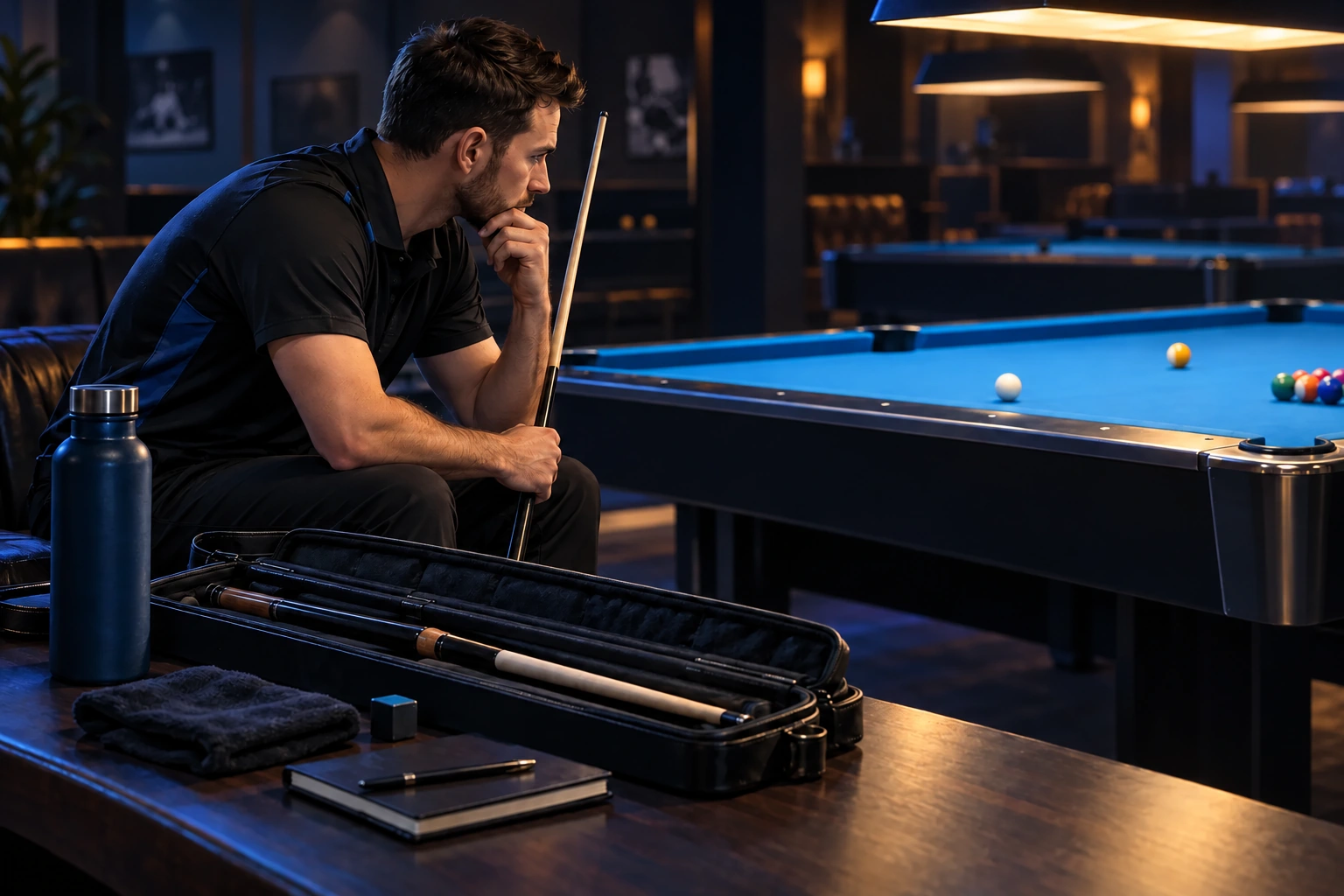
Use a confirmed reporting deadline, not a guessed start
Confirm your check-in, table/reporting instructions, actual game and rules with the organizer. Keep the official call channel available while following device rules. A bracket estimate or another player’s guess is not permission to leave the call area or start a long practice block.
Let B be minutes remaining to a confirmed reporting deadline. Reserve 3 minutes for your own equipment handoff and reporting in the examples below; choose a larger personal margin if the walk or venue needs it. If the deadline is unknown, practice permission is missing or the call may come now, select zero-minute shooting and remain ready. Official instructions and a new call always override this card.
Prepare the first tournament weekend in advance for the separate travel, entry and seven-day fact sheet.
Use the longer general tune-up separately when that actual permitted time exists.
Freeze familiar equipment and one action
An equipment concern is not solved by hitting harder or performing last-minute abrasive maintenance. Use only familiar approved care and service. If replacement equipment is necessary, record the change and keep the warm-up modest; do not claim that it is already calibrated.
Keep one controllable action, such as completing the shot decision before settling. It is not an instruction to force a breath pattern or diagnose a health condition. Ordinary comfort and a familiar routine take precedence over copying a picture.
| Field | Record | Hold boundary |
|---|---|---|
| Equipment | Normal assembled cue, secure tip/ferrule and familiar permitted accessories | Damage or loose part: stop and obtain authorized help |
| Call authority | Official channel and reporting deadline or unknown | Do not use an unofficial delay estimate |
| Practice permission | Actual table/time and activity allowed | No permission means no shooting |
| One action | A familiar controllable routine cue in your own words | No new grip, stance, tip or aiming system |
| Exit | Where to report and time margin | A call ends practice immediately |
Choose a bounded warm-up dose
Use ball-center coordinates on an illustrative 100×50-inch bed: x=0..8 along the length, y=0..4 across it, origin at the lower-left cushion-nose corner. One unit is 12.5 inches; equal 2.25-inch balls have radius 0.09 and diameter 0.18 units. Intact-cushion center limits are 0.09..7.91 and 0.09..3.91. Real pockets interrupt the boundary at four corners and (4,0),(4,4). Measure the actual bed, balls and pocket mouths before scaling. Remove measuring aids before shooting and never mark a competition table.
Object O(6, 3), real corner P(8, 4), intended first-contact cue center G(5.839003, 2.919502), cue start C(4.944576, 2.472288). G=O−0.18u, C=G−u, u=(2,1)/√5; the centers are collinear and tangency is one diameter apart.
Short option: up to two ordinary familiar straight attempts from C,O and up to two cue-only pace attempts from C(1,1) toward chosen rest disk T(4,1),radius 0.18. All setup, resets, rest and notes fit inside 4 minutes. Stop at the boundary even if fewer than 4 strikes occurred; do not rush to reach the ceiling.
Full option: three four-minute blocks, with up to 4 familiar straight strikes,4 cue-only pace strikes at the same T and 4 familiar no-intentional-sidespin cut strikes. Cut object O(6, 2), corner P(8, 4), intended first-contact G(5.872721, 1.872721), cue start C(5.562138, 0.71361). The object direction is (1,1)/√2; the incoming direction is (cos 75°,sin 75°), giving a 30° geometric cut. It is a construction reference, not a sidespin-adjusted aim guarantee. All twelve minutes include setup, rests and resets. There is no required break, jump, massé or new spin task. If a task is not already familiar and permitted, omit it and keep the unused time.
| Confirmed B | Shooting allocation | Actual strike ceiling | Remaining time |
|---|---|---|---|
| Under 7 minutes, or unknown | 0 minutes | 0 | Prepare and report; no invented deadline |
| 7..14 minutes | 4 minutes | 4 | B−4−3 minutes available to remain ready |
| 15 minutes or more | 12 minutes | 12 | B−12−3 minutes available to remain ready |
Record information rather than a match prediction
Record one useful condition observation and its limitation, such as repeated cue-only rests beyond the chosen disk at a familiar pace request. Four warm-up shots are not a calibrated cloth-speed measurement, a tournament win forecast or proof of a defective cue. A single sideways departure cannot diagnose exact contact.
Hypothetical B=20:12 shooting+3 reporting margin+5 ready/quiet minutes=20. Hypothetical B=10:4+3+3=10. If a new call arrives after 5 of the 12 planned strikes, record 5 actual and stop; seven unused allocations are not misses. The same call rule applies during the four-minute option.
A later delay does not require starting the dose over. Track the cumulative attempts already made and stay available. Repeatedly warming up to feel certain can consume the time and energy the card was meant to protect.
Carry one familiar reset and save technical work for later
When the shot picture or plan changes while down, withdraw safely, stand up and choose the plan again within actual event timing rules. Do not introduce multiple mechanical corrections to recover confidence after one miss. A visible equipment fault or safety problem is different: stop and seek the permitted official response.
After the match save one decision that worked, one unresolved condition and one practice question. Do not rewrite the preparation record to fit the final score. The practical outcome here is a ready player with a truthful time and attempt record, not a claim that important matches follow a guaranteed five-step formula.
Turn the remaining question into a later practice decision outside the match-day preparation window.
Sources and further reading
References support the specific factual information above. The practical checklists are Ariakon editorial guidance.